本文转载自 linked-list-good-taste,添加了个人理解的注释
Linked lists, pointer tricks and good taste
Introduction
In a 2016 TED interview (14:10) Linus Torvalds speaks about what he considers good taste in coding. As an example, he presents two implementations of item removal in singly linked lists (reproduced below). In order to remove the first item from a list, one of the implementations requires a special case, the other one does not. Linus, obviously, prefers the latter.
His comment is:
[…] I don’t want you to understand why it doesn’t have the if statement.
But I want you to understand that sometimes you can see a problem in a
different way and rewrite it so that a special case goes away and becomes the
normal case, and that’s good code. […] – L. Torvalds
The code snippets he presents are C-style pseudocode and are simple enough to follow. However, as Linus mentions in the comment, the snippets lack a conceptual explanation and it is not immediately evident how the more elegant solution actually works.
The next two sections look at the technical approach in detail and demonstrate how and why the indirect addressing approach is so neat. The last section extends the solution from item deletion to insertion.
The code
The basic data structure for a singly linked list of integers is shown in Figure 1.

Numbers are arbitrarily chosen integer values and arrows indicate pointers. head is a pointer of type list_item * and each of the boxes is an instance of an list_item struct, each with a member variable (called next in the code) of type list_item * that points to the next item.
The C implementation of the data structure is:
注释:list的item包含两个成员:值和指针变量;list本身是用head指针表示
1 | struct list_item { |
We also include a (minimal) API:
1 | /* The textbook version */ |
With that in place, let’s have a look at the implementations of remove_cs101() and remove_elegant(). The code of these examples is true to the pseudocode from Linus’ example and also compiles and runs.
The CS101 version
1 | void remove_cs101(list *l, list_item *target) |
注释:如果将list理解为(值+指针变量)成员组成的一串数据,那么访问一个成员的前置成员就得用经典的双指针法,因为单链表没有”记忆性”,要额外的前置指针保存前置位置。
考虑边界条件:1.遍历完了都找不到目标成员;2.前置指针在使用前要判空,如果为空,表明第一个节点就是目标节点,这两种情况都属于上述代码的else case处理
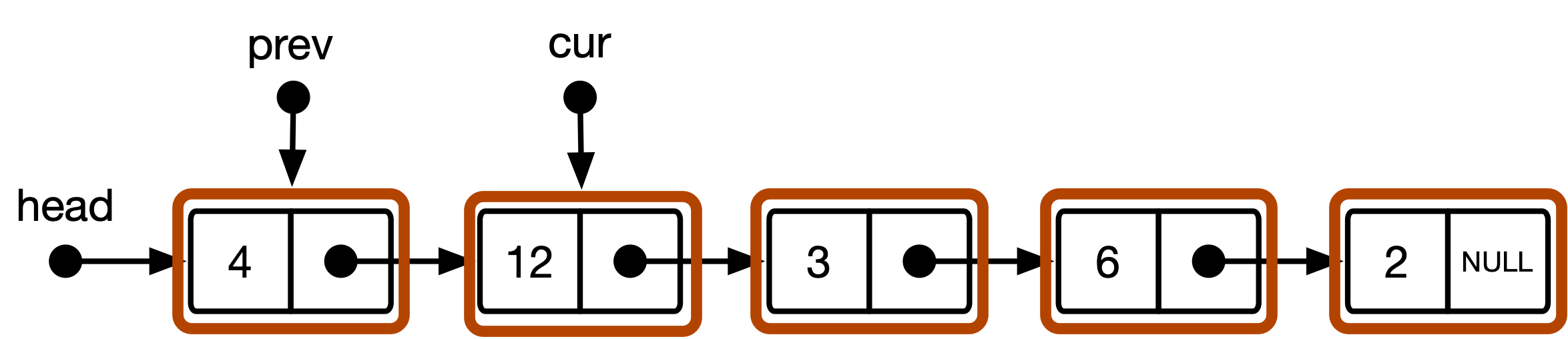
The standard CS101 approach makes use of two traversal pointers cur and prev, marking the current and previous traversal position in the list, respectively. cur starts at the list head head, and advances until the target is found. prev starts at NULL and is subsequently updated with the previous value of cur every time cur advances. After the target is found, the algorithm tests if prev is non-NULL. If yes, the item is not at the beginning of the list and the removal consists of re-routing the linked list around cur. If prev is NULL, cur is pointing to the first element in the list, in which case, removal means moving the list head forward.
A more elegant solution
The more elegant version has less code and does not require a separate branch to deal with deletion of the first element in a list.
1 | void remove_elegant(list *l, list_item *target) |
The code uses an indirect pointer p that holds the address of a pointer to a list item, starting with the address of head. In every iteration, that pointer is advanced to hold the address of the pointer to the next list item, i.e. the address of the next element in the current list_item.
When the pointer to the list item *p equals target, we exit the search loop and remove the item from the list.
How does it work?
The key insight is that using an indirect pointer p has two conceptual benefits:
- It allows us to interpret the linked list in a way that makes the
headpointer an integral part the data structure. This eliminates the need for a special case to remove the first item. - It also allows us to evaluate the condition of the
whileloop without having to let go of the pointer that points totarget. This allows us to modify the pointer that points totargetand to get away with a single iterator as opposed toprevandcur.
Let’s look each of these points in turn.
Integrating the head pointer
The standard model interprets the linked list as a sequence of list_item instances. The beginning of the sequence can be accessed through a head pointer. This leads to the conceptual model illustrated in Figure 2 above. The head pointer is merely considered as a handle to access the start of the list. prev and cur are pointers of type list_item * and always point to an item or NULL.
The elegant implementation uses indirect addressing scheme that yields a different view on the data structure:
注释:核心就是改变对链表数据结构的理解,将链表的最小单元理解为:前置指针 + (值+指针变量)成员,这样需要一个二级指针指向成员内的指针变量,链表也没有特殊性,每个成员一定有非空的前置指针和(值+指针变量),如下图的蓝色框。
这个方法本质上是双指针的优化,只用一个二级指针就可以同时访问目标节点和前置的节点的指针变量,解决了单链表遍历过程中,找到目标节点后无法反向获得前置节点的指针变量的问题。
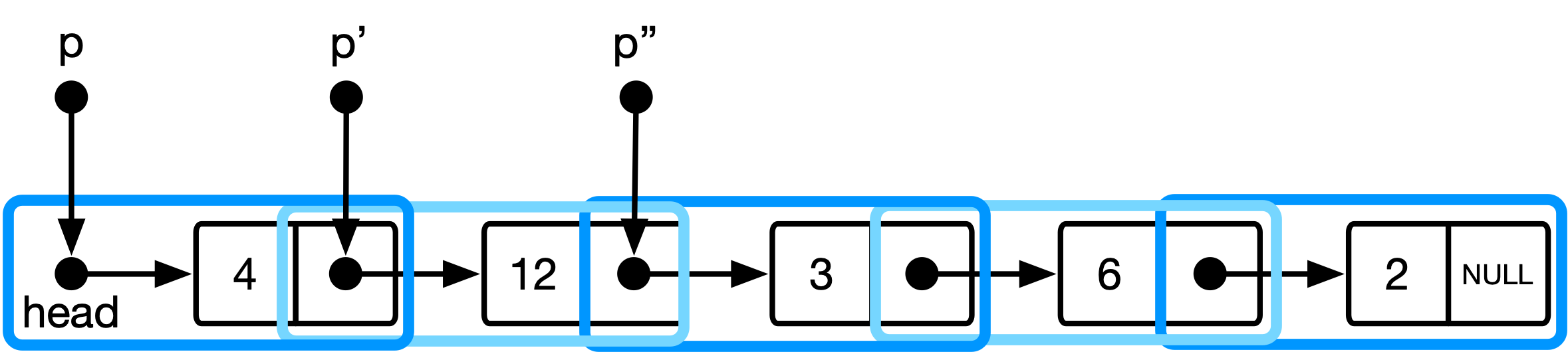
Here, p is of type list_item ** and holds the address of the pointer to the current list item. When we advance the pointer, we forward to the address of the pointer to the next list item.
In code, this translates to p = &(*p)->next, meaning we
(*p): dereference the address to the pointer to the current list item->next: dereference that pointer again and select the field that holds the address of the next list item&: take the address of that address field (i.e. get a pointer to it)
This corresponds to an interpretation of the data structure where the list is a a sequence of pointers to list_items (cf. Figure 3).
Maintaining a handle
An additional benefit of that particular interpretation is that it supports editing the next pointer of the predecessor of the current item throughout the entire traversal.
With p holding the address of a pointer to a list item, the comparison in the search loop becomes
1 | while (*p != target) |
The search loop will exit if *p equals target, and once it does, we are still able to modify *p since we hold its address p. Thus, despite iterating the loop until we hit target, we still maintain a handle (the address of the next field or the head pointer) that can be used to directly modify the pointer that points to the item.
This is the reason why we can modify the incoming pointer to an item to point to a different location using *p = target->next and why we do not need prev and cur pointers to traverse the list for item removal.
Going beyond
It turns out that the idea behind remove_elegant() can be applied to yield a particularly concise implementation of another function in the list API:insert_before(), i.e. inserting a given item before another one.
Inserting before existing items
First, let’s add the following declaration to the list API in list.h:
1 | void insert_before(list *l, list_item *before, list_item *item); |
The function will take a pointer to a list l, a pointer before to an item in that list and a pointer to a new list item item that the function will insert before before.
Quick refactor
注释:单链表的删除节点和前向插入节点有共同的痛点:找到目标节点后无法反向获得前置节点的指针变量,此二级指针方法完美解决这类问题。
Before we move on, we refactor the search loop into a separate function
1 |
|
and use that function in remove_elegant() like so
1 | void remove_elegant(list *l, list_item *target) |
Implementing insert_before()
Using find_indirect(), it is straightforward to implement insert_before():
1 | void insert_before(list *l, list_item *before, list_item *item) |
A particularly beautiful outcome is that the implementation has consistent semantics for the edge cases: if before points to the list head, the new item will be inserted at the beginning of the list, if before is NULL or invalid (i.e. the item does not exist in l), the new item will be appended at the end.
Conclusion
The premise of the more elegant solution for item deletion is a single, simple change: using an indirect list_item ** pointer to iterate over the pointers to the list items. Everything else flows from there: there is no need for a special case or branching and a single iterator is sufficient to find and remove the target item.
It also turns out that the same approach provides an elegant solution for item insertion in general and for insertion before an existing item in particular.
So, going back to Linus’ initial comment: is it good taste? Hard to say, but it’s certainly a different, creative and very elegant solution to a well-known CS task.